Lottery-based elections are the way out for Pakistan
To make Pak democracy deliver in the first place, or say, to improve the quality of Pak democracy (yes, from zero to one and above), up to this moment, I have been focusing on the following aspects of it:
- How to curtail and limit the constitutional powers of the politicians, i.e., those politicians who somehow after winning general elections come to power.
Initially, in a 2012 book of mine, The Rise of State Aristocracy in Pakistan (پاکستان میں ریاستی اشرافیہ کا عروج), I advocated strict constitutional rule as a panacea, as an effective antidote to stifle the capture of the state and its resources by aristocracy (Ashrafiya), thus named Riyasati Ashrafiya (State Aristocracy).
Earlier than that, in 2007, I had penned a Charter of Liberty, in the light of which the constitution of Pakistan needed to be rewritten, and then it might have become a document meant to protect the fundamental freedoms (rights) of the people.
No doubt, that was not sufficient. I was not satisfied with what I had proposed.
Again in 2017, in my book in Urdu, Reconstructing the Social Contract: The Principles of Organizing a Human Society (عمرانی معاہدے کی تشکیلِ نو: انسانی معاشرے کی تنظیمِ کے اصول), I recommended three limitations to be put on the constitutional mandate of the elected politicians. That the mandate be (i) specific, that is, what they could do; (ii) determinate, that is, their powers are not indeterminate; and (iii) conditional, that is, their mandate is conditional to their performance, etc.
- In the same book, after a thorough critique of the principle of representation and Pakistani manifestation of it, I proposed that in matters of vital importance, they be made bound to solicit the opinion of the people via a referendum before making any final decision.
I made financial power, especially to be part of the vital matters. That is, before levying a new tax, that is, any new pecuniary burden, or before increasing an existing tax, that is, any increase in an already existing pecuniary burden, they must be made to solicit the opinion of the people via a referendum.
I thought by curtailing and limiting the constitutional powers of a legislature, the stronghold of Riyasati Ashrafiya (State Aristocracy) could be weakened, and specifically by resorting to a referendum, the size of the financial extraction under the name of taxes could be reduced.
It may be noted that although now my focus has shifted from this aspect of Pak democracy to another aspect, I still believe it can work and that the constitution must incorporate relevant amendments to the purpose.
- In addition to the above two aspects, during the last decade or so my focus has been on the quality of governance also. One may object: low-quality democracy ends in low-quality governance. But as this relationship is tricky, let us leave it for the time.
I wrote and spoke extensively about the dead governance and, in the course of time, discovered another category of governance, the negative governance. A governance that at its best avoids all those things that are required to be done and that at its worst focuses on all those things that are required not to be done.
And, really, that turned me into a pessimist. I believe the governance in Pakistan cannot be improved. It is no place to dwell on the reasons. Suffice it to say that until and unless the stronghold of Riyasati Ashrafiya on the state of Pakistan is not broken and the state is not retrieved back to the people, hoping is a futile exercise.
- And the lot of the political parties is altogether a different story from the quagmire the political system has come to be. I did a whole book on the political parties in 2012, Political Parties or Political Arrangements: A Philosophical Critique of the Intricacies of Politics in Pakistan (سیاسی پارٹیاں یا سیاسی بندوبست: پاکستانی سیاست کے پیچ و خم کا فلسفیانہ محاکمہ).
I have been keeping tabs on the political parties also. And it is a considered and calculated view of mine that the political parties do not represent the people. Then, who do they represent? They represent the Siyasi Ashrafiya (political aristocracy) of the country, which is one of the core classes of Riyasati Ashrafiya. That is why I dubbed the political parties as the trade unions of siyasi ashrafiya.
- Lastly, another most disappointing aspect of Pak democracy is the elections part of the game, as is the case elsewhere, particularly in the developing world.
There is a large think tank, FAFEN (Free and Fair Election Network), and their work is commendable; it takes care of the dynamics of elections. There are many amendments inserted into the constitution, but that did not bring any positive change in any aspects of the quality of democracy.
Generally speaking, there is no satisfaction on this front too. The elections are a mess, from A to Z.
Other than the rigging wholesale or retail, the irregularities small or large, and the interference of the executive authorities and the establishment at every stage of elections, the elections always remain or are made to remain a controversial exercise. So much so that a saying like this goes, Without the patronage of the establishment (now America is behind the screen!), no election can be won.
Despite all that mess and the realization of it, ways out and improvements to make the general elections free, fair, and transparent are found in abundance. However, nothing happens on the ground. Simply because Riyasati Ashrafiy does want to keep the status quo intact.
Here is the light:
Finally, I have the light. Yes, it is like that. It seems it overcomes the quagmires we are in. It can solve many problems. It can resolve a number of issues. And it can hack at the root of Riyasati Ashrafiya’s stronghold on the state. The state can be retrieved and restored (back) to the people. It can improve all the aspects of the quality of democracy in our country.
A week or so ago, I read about a book. It intrigued me immensely. I was eager to have it. And I have it now and have finished reading it. It is the light.
I think, and it comes to mind, that solutions are always so simple that one cannot believe them. They are just before our eyes, and we ignore them. And then someone says it is the solution. And we are awed; oh, it’s the solution!
Yes, it is a book by Helene Landemore. She has written other books. This one is her most recent, appearing in January 2026.
“Politics Without Politicians: The Case for Citizen Rule”
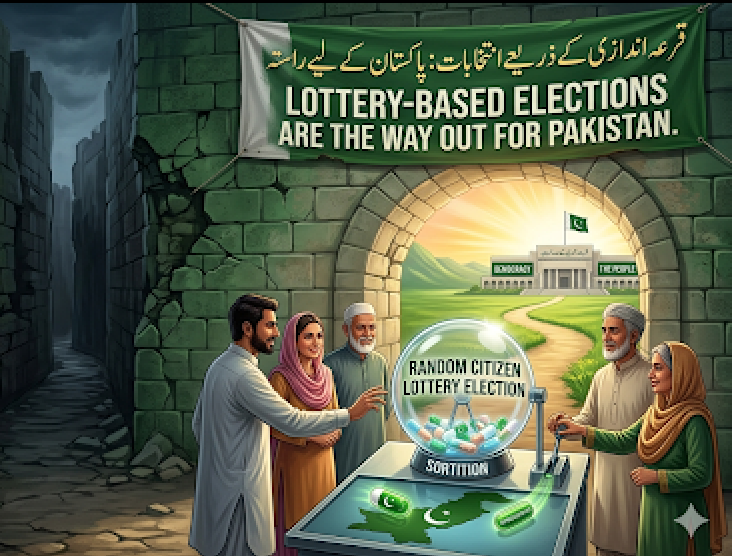
The book substantiates its thesis with cogent arguments and overwhelming historical evidence, and I believe that for a democracy like Pakistan, which has been at a dead end for a long time, lottery-based elections are the way out.
I see how great a leveler they are, the lottery-based elections.
It points to a way out of most political quagmires.
In the words of Aristotle, it says one principle of liberty is to rule and be ruled in turn.
It can provide everybody with an opportunity to be ready for the job, to rule, and to be ruled.
It can allow democracy to run in its truest sense.
It can, in the real meaning of the term, unleash political equality.
It can wipe out the partisan politics and bridge the hateful gaps it has created.
It can open a range of unimaginable avenues to strengthen the spirit of democracy and a democratic culture.
It can do so many miracles, so many things.
In an ultimate sense, it upsets the whole setup of Riyasati Ashrafiya topsy-turvy. What else could do that?
In short, it has the potential to settle so many longstanding political feuds.
Go give a read to the book and be enlightened.
[28 Mar. 2026]