Shah Kharchiyan Aur Mandate Ka Matlab
Please note: This post has been shifted to the Urdu Blog – Civil Pakistan. To see it, click the link below:
Politics at the cost of taxpayers’ money!
Most of the English and Urdu newspapers of today (December 27), published the following full page advertisement on behalf of “Chief Minister Sindh and All Cabinet Memebrs, Information Department, Government of Sindh.” Also, there are other smaller-size advertisements in almost all of the newspapers sponsored by various government departments.
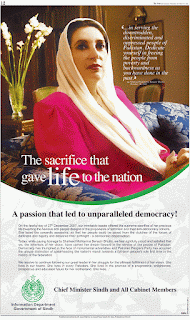
… See this full page ad copied from The News:

I checked online editions of The News, Dawn, The Express Tribune, Business Recorder, The Nation, Pakistan Observer, and Urdu dailies, Express, Dunya, Nawa-i-Waqt; they all contain the full page ad.
What’s hiding behind this Advertisement?
In The News of December 24, on page 5 there published an Advertisement. Here it is:

… 
What does that Ad mean?
How come that suddenly 8816 posts emerge vacant in various organizations working under the Ministry of Interior!
What does this Ad as a whole amount to?
On December 25, The News published Ansar Abbasi’s story, Desperate rush to recruit thousands en masse. This story reveals what may have prompted the publishing of that Ad!
Here is the link to this story: http://www.thenews.com.pk/Todays-News-13-19700-Desperate-rush-to-recruit-thousands-en-masse
In The News of December 26 published another story by Ansar Abbasi on the same issue. Here is the link: http://www.thenews.com.pk/Todays-News-13-19728-Desperate-rush-to-put-favourites-on-key-posts
The same advertisement appeared in an Urdu daily, Express, on December 27. Here it is:


© The Blogger
All rights reserved. No part of the contents published on this Blog – Notes from Pakistan may be reproduced or transmitted in any form or by any
All rights reserved. No part of the contents published on this Blog – Notes from Pakistan may be reproduced or transmitted in any form or by any
Puranay Kaalum – Aik Eff Aai Aar Ki Qeemat
Please note: This post has been shifted to the Urdu Blog – Civil Pakistan. To see it, click the link below:
State Aristocracy’s Pakistan – 5: Justice for the elite class
The News in its print edition on December 23 reported the following:
… Bakery boy absolves CM’s relative, cops of torture
LAHORE: A judicial magistrate of cantonment courts on Saturday adjourned the hearing by January 9 of a case against Ali Imran Yousaf, son-in-law of the Punjab chief minister, eight others including seven officials of Elite Force.
On Saturday, the court recorded the statement of complainant Irfan who said that neither the CM’s son-in-law nor elite force officials had tortured him. He said he had been tortured by unidentified persons.
After recording the statement, the court adjourned the case until January 9.
Previously, the court had indicted the CM’s son-in-law and others including Zafar Hussain, said to be the bodyguard of the Punjab chief minister’s son -in-law, and Elite Force officials Riaz, Yousuf, Mohsin, Maqsod, Farid, Nawab and Khalil Ahmed.
According to the case, an FIR was registered by Umer Hussain,
Pakistan Ke Mujrim – Siyasi Zawiya
Please note: This post has been shifted to the Urdu Blog – Civil Pakistan. To see it, click the link below:
Terrorism thriving in Pakistan – a cartoon
…
Zindagi Se Mahabbat Ki Tareekh
Please note: This post has been shifted to the Urdu Blog – Civil Pakistan. To see it, click the link below:
Two Pakistans
Anyone can see that there is not one Pakistan. After more than 60 years the two Pakistans Pakistan Pakistan Pakistan Pakistan
… Now roam about some areas of the elite Pakistan Pakistans Pakistans
Pakistan Ke Mujrim
Please note: This post has been shifted to the Urdu Blog – Civil Pakistan. To see it, click the link below:
Privatize Gas Fields or Nationalize the CNG Stations!
Ordinary Pakistanis are in the jaws of another government-created crisis: they are facing shortage of Compressed Natural Gas (CNG) in their homes as well as in their vehicles. The other side of the coin is the industrial sector suffering a lot due to the shortage and limited supply of the CNG.
… Years back caught in a fever of Greenism and making policies with no insight into the future, the government promoted CNG. When everything has gone Green, it was revealed that there was no more CNG to feed those who shifted to the use of CNG. Rationing started, and another venue for huge corruption opened. It is in addition to the bucks OGRA (Oil and Gas Regulatory Authority) and Ministry of Petroleum and Natural Resources are making.
In many a city, for most of the time factories are closed, and there are strikes by unemployed factory workers. And there are
Hukoomat Maila
Please note: This post has been shifted to the Urdu Blog – Civil Pakistan. To see it, click the link below:
State Aristocracy’s Pakistan – 4: PM appoints son-in-law as ED World Bank
Prime Minister Raja Pervaiz Ashraf by, using his discretionary powers, has appointed his son-in-law, Raja Azeemul Haq to the prestigious post of Executive Director of the World Bank Washington. The decision was taken despite resistance shown by Finance Minister Dr. Abdul Hafeez Shaikh, who tried to convince the Premier to change his decision, and told him that his son-in-law is “junior” for such an important position.
… The Economic Affairs Division, the department which was asked to formally move the summary by the Prime Minister’s Principal Secretary Ayub Qazi, also opposed the move. The department suggested that a head-hunting committee or selection board should be formed under the Establishment Division to select a suitable candidate.
Raja Azeem is currently serving in the PM Secretariat as the Additional Secretary on a grade 21 post, a position that a civil servant usually gets after serving for two to three decades. Until a few
Saqaafati Ijaradaari
Please note: This post has been shifted to the Urdu Blog – Civil Pakistan. To see it, click the link below:
Media and the Political Princelings
It is strange, rather outrageous that the same media, which is truly active and activist, as regards many a genuine issue, and in certain cases quite imbued with a fighting spirit, is all set to advance the cause of new young leaders of the political elite classes.
… Ah, the senior and experienced media men, the editors, reporters, op-ed writers, and those who are known as political analysts, (and the established newspapers and TV channels), they are all avidly promoting the Political Princelings. Such as: Bilawal Zardari, Hamza Shahbaz Sharif, Moonis Elahi, Maryam Nawaz Sharif, Fizza Gilani, Aseefa Zardari, and all the progeny of political royalty of Pakistan.
How unfortunate for this nation!
In an older piece of writing, euphemistically titled as “Not an elitist media,” I tried to focus on this elitist role of Pakistani media. Here it is:
Not an elitist media!
If you attack the establishment long enough and hard
Saeed Iqbal Wahlah Ke Liye Dou Nazmen
Please note: This post has been shifted to the Urdu Blog – Civil Pakistan. To see it, click the link below:
The Rise of State Aristocracy in Pakistan – Reviews
This book was published by Alternate Solutions Institute in February this year. Originally it is in Urdu, Pakistan Mein Riyasti Ashrafiya Ka Urooj.
… After the Media Release announcing the publication of the book was made, I sent its copies to prominent newspapers, journals, and eminent intellectuals and writers for the purpose of review. However, no one bothered even to acknowledge the receipt of the book except Dr. Tariq Rahman, who called me and told that he had received the book.
Here are the reviews done:
The day (February 21) the Media Release was issued, I received a call from Business Recorder. Its senior reporter, Mohammad Rafique Goraya asked me to send copies of the book; he wanted to review it in the Business Review. On March 3, a review was published.
In The Express Tribune, on April 23, Ali Salman in his article, Rental Power Saga
Mamlukat-e-Ashrafiya Pakistan – Aik Aur Mubarakbaad
Please note: This post has been shifted to the Urdu Blog – Civil Pakistan. To see it, click the link below:
What’s your qualification, Mr. Prime Minister?
How vacuous the speeches and statements of state dignitaries look!
… But it is for them to inaugurate this or that thing, to make speeches! It seems that’s the only thing they can do, at least in Pakistan! Maybe since they have nothing else to do, they like to be the chief guests at many an occasion so diverse in nature that they would never be able to go to were they not in that position.
The difficult part of this exercise requires them to deliver speeches. However, they are privileged – they have speech-writers. That makes their speeches all Greek to understand as the speeches delivered by their very persons. Almost as a rule they are all, again at least in Pakistan, not as qualified and cultivated, or in short so learned that they would naturally be delivering speeches as the occasions require.
So, as far as their speech-writers are
Saqaafati Munaafqat
Please note: This post has been shifted to the Urdu Blog – Civil Pakistan. To see it, click the link below: