The theory of media consumption stands vindicated in Pakistan!
The story goes thus:
On June 29 the Federal Defense Minister, Ahmed Mukhtar, who had been sleeping all through the May 2 Abbottabad-Osama-Bin-Laden and May 23 PNS-Mehran-Karachi happenings, awoke to talk to a group of journalists apprising them that Pakistan had asked Washington to vacate the Shamsi airbase in Balochistan which was used to launch Drone strikes against the militants. The Minister remained awake to tell the Reuters on the following day that Islamabad had been pressing the US to leave the base even before the ‘Abbottabad incursion’ and did so again after the ‘incursion.’
Very next day, the message had already generated its rebuke. The US officials in Washington reacted that there was no plan to vacate the base.
Then it was on July 1 that the Federal Minister for Information, Dr. Firdous Ashiq Awan, had to settle the matter.
When creative spirit of a nation is arrested from within, it is as vulnerable to external insinuations as is to internal machinations, and can never make any progress.
“Pakistan is under siege.”
We had enemies from the very first day. With time, the list of our enemies grew longer. So much so that today we have neighbors not friendly to us and a world all hostile to us. We are alone in a wilderness created of our own. Isn’t it Greek mythology whose gods and monsters we have resurrected in ourselves? Like the one-eyed monster, we have no second eye to look inward. This on the one hand has transformed us completely into subjects perfectly suitable for psychological pursuits. Or, for instance, how can a judge of a higher court find fault with bare feet of a dancer, and ban it? Or
When creative spirit of a nation is arrested from within, it is as vulnerable to external insinuations as is to internal machinations, and can never make any progress.
“Pakistan is under siege.”
We had enemies from the very first day. With time, the list of our enemies grew longer. So much so that today we have neighbors not friendly to us and a world all hostile to us. We are alone in a wilderness created of our own. Isn’t it Greek mythology whose gods and monsters we have resurrected in ourselves? Like the one-eyed monster, we have no second eye to look inward. This on the one hand has transformed us completely into subjects perfectly suitable for psychological pursuits. Or, for instance, how can a judge of a higher court find fault with bare feet of a dancer, and ban it? Or
When creative spirit of a nation is arrested from within, it is as vulnerable to external insinuations as is to internal machinations, and can never make any progress.
“Pakistan is under siege.”
We had enemies from the very first day. With time, the list of our enemies grew longer. So much so that today we have neighbors not friendly to us and a world all hostile to us. We are alone in a wilderness created of our own. Isn’t it Greek mythology whose gods and monsters we have resurrected in ourselves? Like the one-eyed monster, we have no second eye to look inward. This on the one hand has transformed us completely into subjects perfectly suitable for psychological pursuits. Or, for instance, how can a judge of a higher court find fault with bare feet of a dancer, and ban it? Or
The middleman tends to be eliminated . . . He can only be safely eliminated by natural processes. Sometimes he is of real use and helps production; sometimes he is not; but this cannot be decided by a blind strike, but only by allowing the forces of competition to act upon him.
[Hon. Auberon Herbert]
Every time Pakistan Muslim League (N) comes to govern in Punjab, it tries its hands at innovative approaches to solve some of the crucial problems facing ordinary citizens. But unfortunately all of them prove unproductive, consume resources wastefully, and leave the ‘attempted problem’ in a greater mess. An important case in point is the problem of public transport – requiring resolution since long. In this regard, every new innovation can be cited as evidence for its previous failure. It seems the Party is fond of focusing
…
How to Privatize Successfully – Part I
If privatisation needs to be done, it has to be done because it is the decisive step in transforming the economic system. Regarding foreign help Dr Klaus is very blunt: I think that the typical foreign help was sending would-be advisors and consultants. It became one of the most profitable businesses in the 1990s – to become a consultant and advisor in the transforming societies.
Their recommendations weren’t useful and not very good. You have had some experience with troubles in South East Asia in the second half of the 1990s – it seems to me that it has become an accepted truth that it was a tragic mistake of IMF policies for all of what happened in countries like Indonesia, Malaysia and elsewhere.
And, he goes
…
Changing the economic system is not an easy task. And, of course, it is more complex when carried out half-heartedly. As privatisation is only a part of this process, it may not succeed if done in an isolated manner. It needs certain other changes and a competitive environment to bear fruit.
A case in point is Czechoslovakia. It provides us with a very good learning experience to see how after the fall of a collectivist state the gigantic task of changing the economic system was handled.
Presently, Dr Vaclav Klaus is President of the Czech Republic. He was Prime Minister from 1992 to 1997. Dr Klaus was one of the key members of a movement, Velvet Revolution, which overthrew communism in Czechoslovakia and one of the founders of the Czechoslovak Civic Forum Movement, the leading political organisation following the Velvet Revolution
He knows nothing; and he thinks he knows everything. That points clearly to a political career.[George Bernard Shaw, 1856-1950]
People are difficult to govern because they have too much knowledge.
[Lao Tzu, 604 BC – 531 BC]
Underneath our views of everything lies a theory of knowledge.
We have views about the world, and what exists in and beyond the world. We have views about man, his nature, his destiny, and his place in the society and the world. We have views about society, about people and about the things people believe in and do not believe in and about things people do and do not do. We have views about everything. Sometimes we are aware of the implications of our views and sometimes not. But most of the time we are never aware of the theory of knowledge lying behind our views.
We make a cultural conviction: The
…
[Here is the part 4 of the article: “Cynicism and Pakistan.”]
The Theory of Lesser Evil (TLE) is a manifestation of cynicism. As cynicism finds its meaning mainly in negativity and faultfinding, TLE too believes that everything is Evil; there is no Good. If everything is Evil, and there exists no Good, then what we are free to do is make a choice between all the Evil things. Nonetheless, TLE makes room for things which are more Evil and which are less Evil. This seems to be a ploy to carve out a niche for human choice; otherwise, if everything is Evil, then there is no question of making any choice. In that case, we are all condemned and doomed to live with Evil. But the choice between the things more Evil and the things less Evil allows for us to live with things which are less Evil. Herein lie
You can bring the rich to the level of the poor overnight but it takes a lifetime to lift the poor to the level of the rich.
– Irish proverb
During the 1970s, Pakistan went in for wholesale nationalization of its private enterprises, taking even educational institutions into the state’s hands. This was a move laden with far-reaching and unforeseeable consequences. Some are still being unveiled today. It changed not only the economic and political, but also the social, intellectual and moral landscape of the country for generations to come.
The story began in 1968, with a political movement basing itself purely on totalitarian economic agenda. Its slogans were reminiscent of an ancient collective tribal life where everything belonged to everyone. Two of these were: ‘socialism is our economy’ and ‘all power to the people.’ The movement was built on the myth of 22 wealthy families: it was argued that
…
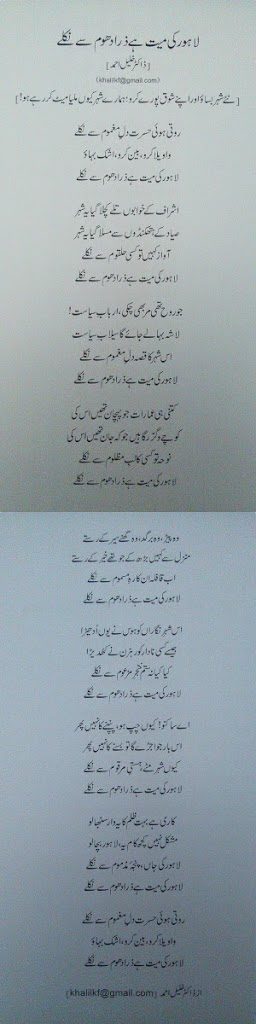
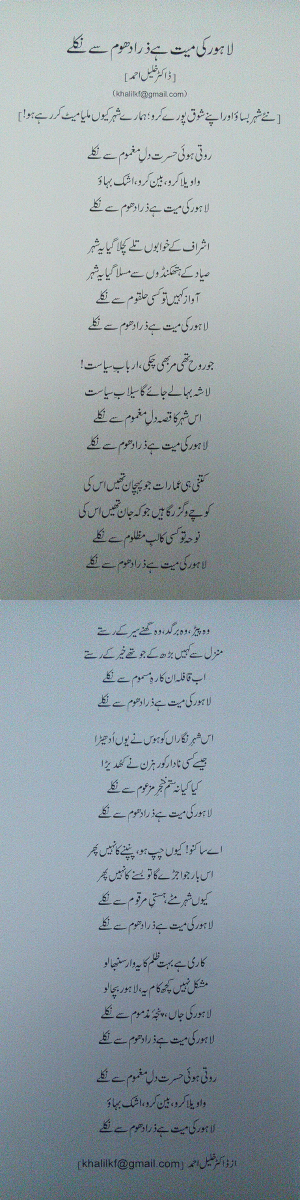
O the Ashraaf Rulers! Develop new cities and have your dreams fulfilled; have Metro Buses and Metro Trains there and whatever you want! Why do you raze and destroy our cities, our Lahore!
Let we have our own dreams live in the cities where our souls live!
لاہور کی میت ہے ذرا دھوم سے نکلے
[نئے شہر بساؤ اوراپنے شوق پورے کرو؛ ہمارے شہر کیوں ملیامیٹ کر رہے ہو!]
روتی ہوئی حسرت دلِ مغموم سے نکلے
واویلا کرو، بین کرو، اشک بہاؤ
لاہور کی میت ہے ذرا دھوم سے نکلے
اشراف کے خوابوں تلے کچلا گیا یہ شہر
صیاد کے ہتھکنڈوں سے مسلا گیا یہ شہر
آواز کہیں تو کسی حلقوم سے نکلے
لاہور کی میت ہے ذرا دھوم سے نکلے
جو روح تھی مر بھی چکی، اربابِ سیاست!
لاشہ بہا لے جائے گا سیلابِ سیاست
اس شہر کا قصہ دلِ مغموم سے نکلے
لاہور کی میت
[Here is the part 3 of the article: “Cynicism and Pakistan.”]
The discussion of the political cynicism here focuses only on the sections of society which exercise influence on the formation of public opinion. These sections may be considered as the mainstay of political cynicism in Pakistan. As far as the general citizenry is concerned, the myth of its political apathy evaporates with every general election held in the country. One may object: the turnout in the elections is too small to break this myth. However, the statistics belie it: the turnout in 2008 stood at 44 % and in 2013, 55 %. In the world’s largest democracy, India, it was 64 %.
The mainstay of political cynicism in Pakistan comprises academics, intelligentsia, journalists, TV channels talk show hosts (as well as announcers!), Urdu/English newspaper columnists and op-ed contributors, and authors of books on various subjects but with a political
…
The credit for any reduction in poverty in the country goes to privatisation, de-regulation and liberalisation, not to the so called pro-poor expenditures.
Over a period of five years between 1999-2004, the government of Pakistan spent Rs.1 trillion on poverty reduction. According to the Finance Ministry, Poverty Reduction Special Programme included budgetary and non-budgetary expenditures both by the federal and provincial governments.
Now, the ‘Labour Force Survey 2005’ (first two quarters) reports that over the last five years, the government has spent a hefty amount of Rs.1332 billion on poverty-related and social sector programmes to help the poor and vulnerable sections of the society. The PRSP expenditures — budgetary and non-budgetary — during 2001-05 stood at Rs.1124 billion; the budgetary expenditures averaged 4.1 per cent of the GDP for the period. Of this, the government spent Rs.316.2 billion on pro-poor sectors exceeding the targeted Rs.278 billion by Rs.38 billion. And,
…
Here is the 1st part of this article:
Cynicism in Pakistan
Cynicism and the politics in Pakistan
Among other things, political cynicism destroys whatever little chance may exist for dialogue in a deteriorating situation. This I learned from our own company of friends. Frankly, that learning came at the cost of that company’s dissolution.
Actually we were three to five friends who used to gather in a restaurant for chatting after a week or so, regularly. One friend was too adamant to sustain a dialogue. It was really next to impossible to converse with him. You say one thing and he will trash it without any consideration. No doubt, he was fond of conspiracy theories, and thus for him it was so easier to reject our views without having any recourse to reason. His manner of rejecting our views was so scornful that one could only bear it by blowing
It’s always been argued that there is no clergy among the Muslims. Is it so? Not the least! In fact, there is all the ‘required’ evidence available to defy this claim. Regardless of the positions and interpretations the Muslim scholars advocate in this respect, there always existed and still exists such a body of religiously ordained persons who use their authority in worldly as well as other-worldly affairs of the Muslims. Even if there is no Muslim Church like the Christian Church, the Principle of Clergy for all the practical purposes is the same in Muslims. It may also be added that unlike the Christian Church, where a uniformly organized clergy or popery exists, in Muslims though the same institution does not exist in the same manner, the principle of clergy does exist religiously in an un-organized and politically in an organized manner. Hence, what’s important is not the institution,
…
پاکستن کے سیاست دانوں نے، خواہ وہ جمہوریت کا لبادہ اوڑھے ہوئے ہیں یا مذہب کا، قریباً ستر برس سے یہاں کے شہریوں کو ٹرک کی بتی کے پیچھے لگایا ہوا ہے۔
This Urdu saying means: Paki politicians, whether they are clad in the garb of Democracy or Religion, have got the citizens running after the back-lights of a Truck! In other words, the citizens of Pakistan have been made to run after a mirage so that they are never going to reach any destination.
Recently, there was a book-launching in Lahore. The book’s title is: NauAbaadiyati Taaleemi Dhaancahy Ka Tasalsul (The Continuation of Neo-Colonial Educational Structure) and it’s written by a Marxist. All the talk there focused on castigating the British for their doing everything in their own interest. Two or three sane voices, speaking common-sense, tried to make other commentators realize not all that is bad had been
…
Note: The day Benazir Bhutto was murdered, December 27, 2007, it was the day when all the semblance of government evaporated in Pakistan; there was widespread anarchy and uncertainty; there was arson, loot, and destruction. Fear prevailed. As if the life and property of ordinary citizens of this country were forsaken by the State! Here is the Story:
Where there is no property there is no injustice.
John Locke
Regardless of the controversy whether we human beings are by nature good or bad, what is crucially required to keep our society intact is that we must be treated as free agents. This washes away all those excuses the science of psychology and its Freuds and no-Freuds have heaped on and which provide an eternal alibi for the criminals to prove their innocence under the guise of this or that mental state or illness, or this or that instinctual impulse which,
…
This article was written last year in the wake of December 16 APS Tragedy to expose the Politicians’ inaction. It’s still relevant today on December 16, 2015.
The road ahead is quite straight
Beware of the politicians! They cannot think and act out of their politically blocked mentality! They are a victim of paradigms made of their own choice; that’s why they disdain rules, laws and the constitution, which require and bind them to act accordingly. They won’t break the paradigms, which ensure their short-term survival, and it’s seldom that they shift to newer paradigms of thinking and action in a broader perspective. Whenever that happens, that happens temporarily and perforce due to the force of the circumstances, like the one which the December 16 Peshawar massacre of the children generated, or under the pressure of the “Subjects,” “Awaam,” like the one which got Iftikhaar Muhammad Chaudhry former Chief Justice
…