Valentine’s Day Ke Liye Aik Nazm
Please note: This post has been shifted to the Urdu Blog – Civil Pakistan. To see it, click the link below:
Who are these “Men of Opinion” – promoting their opinion at the cost of taxpayers’ money! – 1
In Pakistan, political meanness has thousands of ways to maneuver the things!
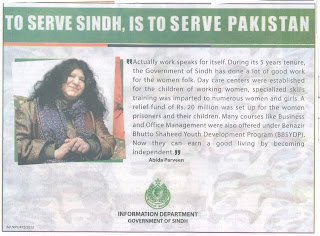


… Obviously, if one doesn’t follow moral principles, no rules, no laws could restrain him from doing what he is intent upon doing!
In view of the forthcoming general elections in the country, “The ECP(Election Commission of Pakistan) has slapped a ban on ads carrying pictures ofpolitical leaders on TV channels and newspapers. It also warned of action overviolation of its directives.” (The News, January 4, 2013)
However, among other things, for the last few days, newspapers are publishing the following ads with pictures of “men of opinion” commending the “Services of the Government of Sindh.”
See some instances:
[The News, February 9, 2013]
[The News, February 10, 2013]
[The News, February 11, 2013]

[The News, The Express Tribune, Roznama Express, February 12, 2013]
Mafiya Siyasat Ki Janam Kundli
Please note: This post has been shifted to the Urdu Blog – Civil Pakistan. To see it, click the link below:
Saving Humanity from the Grind of Education
The Grind of Education is milling generations of human beings to waste their life, talent, creativity, and the genius of their unique individuality in a drab of degrees and diplomas. It’s by taxing heavily the growth and development of the human world holding it back instead.
… That’s why especially political elites (read States and Governments) are fond of it. They have inspired a huge industry of NGOs and a flourishing crop of intellectuals to come to exist which remain busy to put more and more pressure on states and governments to allocate more and more funds for Education.
Among other things, that justifies the political elites’ indoctrination of individual citizens with their ideologies. It’s a long list of unending artificial constructs, such as nation-ism, ethnic-ism, class-ism, religion-ism, sect-ism, language-ism, province-ism, party-ism, clan-ism, caste-ism, so and so forth, that by feeding which the political elites prey on the lives of individual
Muslim League (Nawaz) Aur Punjab Mein Public Transport Ki Kharabi
Please note: This post has been shifted to the Urdu Blog – Civil Pakistan. To see it, click the link below:
Dr. Abdus Salam and his Science of Development
Intellectually Pakistan is quite a barren country.
… One reason, it has never encouraged the spirit of free inquiry.
Instead, it goes for short-cuts to grab “progress,” “growth,” “development,” — thinking them as separate manifestations having no links with knowledge.
In the wake of 9/11, in a local mosque in Shahdrah, Lahore, it was prayed: O God, give us all that America has achieved!
Professor Dr. Abdus Salam too contributed to that short-cut thinking. Especially during Zia-ul-Haq regime and at his instance, there were hectic efforts to promote the education of Science and Technology in Pakistan.
I had reservations on that approach, and wrote the following letter to Dr. Salam:
Lahore, Pakistan
May 2, 1988
Dear Sir,
Of course, it is not pleasant to differ with our ideas, but one cannot help, he ought to disclose his differences honestly.
You are of the clear opinion that to attain the present level
Baldiya Factory Saniha – Intiqaam Ya Insaaf
Please note: This post has been shifted to the Urdu Blog – Civil Pakistan. To see it, click the link below:
The Kashmir conflict: how to keep it alive
The Kashmir conflict, like other ones such as Palestine, does have a history. Parties to it write, rewrite and exploit this history to a point where its ability to offer a solution becomes precarious. Besides, this kind of use of history complicates the conflict inextricably, and one wonders whether it would ever be possible to resolve it. So, I think, instead of delving into the history of Kashmir conflict, it’s better to look forward to its possible resolutions.
For the last decade, I have ignored the news stories on Kashmir (and Palestine, as well). I do not read them with serious attention — not that I am callous to the suffering of the people, but because I am too much concerned with the misery of the people, the real victims of these conflicts. Also, because I know what the stories may contain; I know what they would recount; I know
Taraqqi Pasand Musannifeen, Angrezi Navel Aur Media
Please note: This post has been shifted to the Urdu Blog – Civil Pakistan. To see it, click the link below:
Pakistan Ne Hamain Kya Diya?
Please note: This post has been shifted to the Urdu Blog – Civil Pakistan. To see it, click the link below:
State Aristocracy’s Pakistan – 16: Make a fake project and plunder the tax money of the citizens
Enver Baig’s 2008 report on ‘Tawana Pakistan’ still not implemented
… ISLAMABAD:The National Accountability Bureau (NAB) took almost four years to probe multi-billion scam of Tawana Pakistan Project and is still probing, but a Senate sub-committee headed by former Senator Enver Baig in September 2008 had investigated the scam and identified all the accused involved in it. However, the findings were dumped in the Senate Secretariat since 2008 and government did not touch it. During his tenure as a senator, Enver Baig continued to raise hue and cry for taking action against all accused on the basis of his report, but all proved to be a cry in the wilderness.
The sub-committee of the Senate Committee on Social Welfare headed by former Senator Enver Baig had recommended to the government to take stern action to recover the embezzled public money which was spent on purchase through fictitious bills and by
Karachi Baldia factory fire – revengeful bias, elitist clout, or lawful justice?
On the one side are the victims’ families, Leftist groups, and NGOs, and the sympathizers of the victims of the Baldia factory fire, who demand that the owners of Baldia garment factory be tried for planned murder of the workers. Finally they have come to demand that the said factory be converted into a rehabilitation center for the victims’ families.

… Looking for a way out? – SHC reserves order on Baldia factory owners’ bail plea

[The photo published in The News on January 29, 2013]
“Several NGOs had gone to court on Saturday (Jan 26) against Prime Minister Raja Pervez Ashraf for his alleged interference. They also asked the court to order conversion of the factory into a rehabilitation centre for the victims’ families. The division bench headed by Justice Maqbool Baqir issued notices to the respondents to file their respective comments by February 14.”
[The Express Tribune,
State Aristocracy’s Pakistan – 15: Government waived Rs.360 billion in taxes, duties in 5 years
Senate question hour: ‘Govt waived Rs360b in taxes, duties in 5 years’
… ISLAMABAD: The government waived taxes and duties worth Rs.360 billion to various entities in the last five years through official orders, State Minister for Finance, Saleem Mandviwalla informed the Senate on Tuesday.
The Statutory Regulatory Orders (SROs), official paperwork without which the bureaucratic machinery does not move, were issued to accommodate the waivers and by-pass existing laws that could not be changed overnight, Mandviwalla said, replying to a question posed by Pakistan Muslim League-N Senator Nuzhat Sadiq.
During its tenure the government waived around Rs.298.1 billion worth of inland revenues, including income tax and sales tax, and Rs.61.3 billion worth of customs duties.
The SROs on tax collection from export-oriented sectors, including textile, could not be changed under the existing circumstances. “The exporting sectors enjoy a zero-rate tax to provide them a competitive edge in the international market
Kya Admiral Fasih Bokhari (Retired) Badal Gaye Hain?
Please note: This post has been shifted to the Urdu Blog – Civil Pakistan. To see it, click the link below:
Has Admiral Fasih Bokhari (Retired) now changed?
It was back in the days when the lawyers’ movement for the rule of law was at its zenith. On the 9th of March, 2007, a word of NO uttered by a man representing the law before a man representing the might had acquired the status of a catchword. The same NO had come to symbolize a movement for the supremacy of the law in Pakistan. Such a moral strength was latent in that NO that it had awakened the consciences dead in slumber for decades. Endorsement for the rule of the constitution and the law in Pakistan came from such unexpected quarters where voices supporting the military dictatorships used to come from heretofore. Surprisingly they were the same people who gave finishing touches to the past military takeovers. That was the greatest moral victory of this movement!
… Then, came the day all bright with the restoration of Iftikahr
Riyasati Ashrifiya Ka Pakistan – 14: Shahrukh Jatoi Ka Bairoon-e-Mulk Faraar
Please note: This post has been shifted to the Urdu Blog – Civil Pakistan. To see it, click the link below:
State Aristocracy’s Pakistan – 13: PIA official delays flight for his daughter to board
Great people to fly with!
… LAHORE: A senior PIA official caused the PK 562 Karachi-Islamabad flight to land at the Allama Iqbal International Airport late on Tuesday night to allow his daughter to board the flight, reports Geo News. Later, the flight took off with the girl on board and reached Islamabad.
[The News, January 30, 2013]
State Aristocracy’s Pakistan – 12: Pak politicians taking our taxes, not paying their own: UK minister
Pak politicians taking our taxes, not paying their own: UK minister
… LONDON: International Development Secretary Justine Greening has defended giving millions in aid to Pakistan amid suggestions the Pakistani politicians were “taking our taxes” while not paying their own.
Pakistan receives more money in aid than almost any other state but a report last December claimed two-thirds of its MPs have not filled out tax returns, including its top rulers. Sir Malcolm Bruce, chairman of the Commons International Development committee, raised fears that Pakistan’s approach was “we’ll take your money and do what we please.”
He asked the secretary of state: “What influence do we have over the Pakistan government? They are taking aid programmes; they are taking our taxes, not paying their own taxes. There are billions of pounds they have got in bank accounts yet they are taking money from the IMF. Everybody collectively says we expect them
Na Ehel Aur Ghair Haazir Hukoomaton Ke Nataayej
Please note: This post has been shifted to the Urdu Blog – Civil Pakistan. To see it, click the link below:
State Aristocracy’s Pakistan – 11: Avenging the law!
LHC stays proceedings in PML-Q MPs damages suits
… LAHORE: The Lahore High Court on Monday stayed the proceeding of a civil court hearing Rs 50 million damages suits of PML-Q MNA Ch Wajahat Hussain and MPA Moonis Elahi against former additional deputy inspector general FIA and investigation officer of NICL scam case, Zafar Qureshi.
The court issued this order on a petition moved by Zafar Qureshi challenging order of lower court wherein his plea for dismissal of suit was rejected.Chaudhrys of Gujrat had filed suits against Qureshi alleging that he had tarnished the image of their family and damaged their political goodwill to a great extent.
Zafar Qureshi through his counsel Khawaja Saeeduz Zafar contended that he had no personal grudge against Moonis Elahi or his family and conducted investigation purely on merit in the light of Supreme Court’s directions.
He pointed out that such suits could not be